Friday, 13 November 2009

Out With the Bad Mercenaries, In With The Equally As Bad Ones

As people may work out from my political views, I'm not a reader of FHM. However, on spotting a copy of the December 2009 issue which featured an article on mercenaries, I grabbed it a scribbled down a few notes from the issue, the following piece is what I've gleaned from it.

The most famous currently existing mercenary company (or civilian contractors as they prefer to be known) in the world today is probably Blackwater, responsible for the Nissour Square shootings and numerous other incidents in Iraq which propelled them into the spotlight. Such was the turmoil, that they have now changed their name to the more corporate Xe and are supposed to be being ejected from Iraq (although they have had certain contracts extended such as $20m aviation contract and are getting new contracts in Afghanistan) and replaced by other firms.

A review of the Jeremy Scahill book on Blackwater will shortly be appearing on this blog, so I won't go into too much depth on them. But the article provides interesting information on how Blackwater's fromer head, Erik Prince, has dealt with some of these incidents - for example redeploying men who had been sent home for steroid abuses, claiming that sending them home was weasting company money, or the rumour that they (Blackwater) were "...offing anyone who tried to alert the authorities about Blackwater's (allegedly numerous and ongoing) war crimes."(pg193)

However, the US are gradually handing Blackwater's contracts to other groups, mainly DynCorp. Although the coalition troops themselves are being deployed from Iraq, the article states that mercenaries hired by the US increased from 10,743 in March to 13,232 in June. Moreover, DynCorp's reputation isn't any better than Blackwater's.

The article lists a whole load of alleged shady goings on that the company have been involved with such as that,

"Two DynCorp employees seperately alleged that the company was running a sex-trafficking business during the Bosnian war in the 90's. Teenage girls were traded as slaves between DynCorp contractors. They were brought in from Romania and Russia thanks to collaboration with the Serbian mafia"(pg194)

"Meanwhile their cavalier attitude to crop-spraying while combatting the South American drug trade meant that ordinary crops got destroyed and children died..."(pg194)

"DynCorp has also being accused of sexually exploiting the local womenfolk in the Middle East. A subcontractor was killed in 2003 by a bullet penetrating the unprotected car he was riding in. Where was the armoured DynCorp car that he was meant to have? Ferrying prostitutes between DynCorp hotels in Kuwait and Baghdad, according to another subcontractor testifying at a Senate committee this year."(pg194)

The final thing that I picked up from the article was a contradiction within it. Towards the end of the article it argues that the US government finds it cheaper to pay contractors $60k-70k a year rather than the $100k it costs for a soldier in training, food, salary, healthcare, pensions etc. Yet at the same time, it talks of these mercenary contractors massively exceeding their budgets, such as DynCorp exceeding its Iraq budget by 51% and overbilling the government by $13.3bn. I'm not sure I understand the economics of mercenaries and I will have to come back to this issue at a later point.

Wednesday, 30 September 2009

Review: The Everlasting Staircase: A History of the Prison Officers’ Association 1939-2009

From the September 2008 issue of Socialism 2008.

By David Evans with Sheila Cohen, Pluto Press, 2009, £15

Reviewed by Iain Dalton

WHEN PRISON officers went on their first ever nationwide strike two years ago, it propelled their organisation, the Prison Officers Association (POA), into the spotlight as, ironically, their leaders were threatened with imprisonment if they did not call off the action. Yet the history of trade unionism within the prison service goes back way further than this action or even the formation of the POA in 1939. Until now, it has been a relatively unwritten story, so the publication of a fairly comprehensive history is most welcome.
David Evans begins his narrative with the coming into being of the modern prison in the late 19th century and the attempts of the newly-created salaried gaolers to resolve their grievances. While a few attempts were made to form a trade union organisation in the early 20th century, it was not until the setting up of the National Union of Police and Prison Officers (NUPPO) in 1913 and the Prison Officers Federation (POF) in 1915, that this was achieved. Both unions were illegal, as a Home Office standing order was interpreted by then home secretary, Winston Churchill, as meaning that prison officers should be treated like the police, soldiers and sailors and banned from organising a union.
However, the NUPPO-organised walkout of the Metropolitan police in August 1918 over pay changed everything, with the government verbally backtracking over pay, conditions and the right to form a union. The apparent success of the action led to NUPPO and the POF merging. Yet, within a year of this apparent success, the government felt strong enough to pass the 1919 Police Act which once more took trade union rights away, at the same time attempting to buy off police officers with a substantial pay increase. NUPPO organised strike action in protest, but this was badly undermined with only a small number of police officers coming out as well as a few prison officers in Birmingham and 70 from Wormwood Scrubs. All those who took action were dismissed. The additional disillusionment following the failure of the 1924 Labour government to reinstate the strikers severely disappointed many who had been involved with NUPPO.
Instead of trade union rights, prison officers were left with an ineffectual representative board and, for the next 20 years, pay and conditions deteriorated, steeling the determination of prison officers to secure trade union rights once again. Despite the earlier association with police officers and the fact that the Police Act was used by the Home Office to designate prison officers as having police constable status and so banning them from forming a trade union, the struggle for union rights in the prison service has more in common with those of civil servants. Indeed, it was two leaders of the Civil Service Clerical Association who assisted in spearheading the POA’s right to exist and represented the fledgling POA in negotiations.
The newly-formed POA quickly reached a very high density of membership within the prison service, covering all prisons in England, Wales, Scotland and Northern Ireland. It quickly expanded in 1942 to win rights to represent staff at special hospitals such as Broadmoor. The period after the second world war saw a massive expansion of the prison population, almost doubling between 1945 and 1950. Prisons became overcrowded, with prison officer numbers failing to keep up with the increased population which, when combined with reforms improving prisoners’ conditions, began to breed resentment.
As Evans explains, it was not because prison officers were fundamentally reactionary, as some would claim, but that many of the improvements in conditions came without increasing staffing levels to ensure the safety of both prisoners and staff. This is not to say that the POA did not support improvements in prisoners’ conditions. For example, the POA was instrumental in ending ‘slopping-out’ and forcing the prison service to invest in integrated sanitation. But the overcrowding and extra duties imposed on officers led to the situation in the 1970s and 1980s where prison officers were required to do massive amounts of overtime just to keep prisons functioning.
The period from the late 1960s to the late 1980s was full of POA disputes and struggles which there is not the space to go into here. Importantly, however, this was when the POA discovered one of its most potent dispute tactics: refusing to admit prisoners above the Certified Normal Accommodation (CNA) limits, which highlighted both prison overcrowding and understaffing. There are also other interesting points that Evans raises, such as how prison officers treated the Pentonville Five dockers imprisoned for trade union activities, for instance, by leaving their cell doors open.
But it was the confrontation with the Tory government of John Major in the early 1990s that shaped the major concerns of the POA in recent years. Continued overcrowding of prisons led in 1993 to refusals to accept more prisoners at Hull and Preston, the latter already operating at 200% of the CNA. The Home Office went to court to seek an injunction against this action, and the judge, as well as ruling the action illegal, went further than the Tories in declaring that the POA was not a trade union. This was formalised by the Tories in the 1994 Criminal Justice and Public Order Act, which instituted the infamous section 127 which criminalised calling for prison officers to take industrial action.
Combined with this was the beginning of prison privatisation. Even the Thatcher government thought this was a step too far. But, in the early 1990s, starting with Wolds remand prison and court escort services, the Tories began opening up prisons and related areas to privatisation as well as privatising any new-build prisons. Not only did the privatised prisons attack the pay and conditions of staff, they also refused initially to recognise the POA. Instead, they recognised the scab Prison Service Union, which had been set up by disgruntled ex-POA officials, in ‘sweetheart’ deals. Faced with the market testing of public-sector prisons, the POA decided to organise within privatised prisons and fight for their return to the public sector. The POA’s campaign has been partially aided by some privatised prisons returning to the public sector after private mismanagement, as well as the embarrassing failure of any private-sector tenders to run Brixton prison when it was market tested.
Despite assurances from New Labour in opposition that it would fully reinstate prison officers’ trade union rights and reverse privatisation of the prison service, the POA has been let down on both counts. This led to the POA general secretary, Brian Caton, tearing up his Labour Party membership card at the 2009 POA annual conference. Trade union rights were partially restored on condition that the POA signed up to a no-strike agreement. However, such were the appallingly low pay offers that prison officers were receiving (even compared to other public-sector workers) that the POA pulled out of the agreement and undertook national strike action in 2007. The Ministry of Justice then reinstated the Tory legislation banning strikes by prison officers. This has led to the POA calling for the TUC to organise general strike action against the anti-union laws, as well as bracing itself for the possibility that the courts will be used against it if the POA is forced to take action to defend its membership.
Overall, the book is a very detailed history of the POA. However, there are several areas where more detail on particular issues would be welcome, as well as some areas which are not commented on, such as the alleged influence of the National Front in prisons and the POA in the 1970s. Also, on some points, the narrative is a little confused, jumping backwards and forwards in time rather abruptly. This is partially due to having to cover the specific intricacies of the issues the POA was dealing with in Northern Ireland and Scotland. But these criticisms should not put off anyone who is interested in the POA from reading this well-researched book.

Wednesday, 16 September 2009

Interview with POA leader Brian Caton - Fighting for the right to strike

Below I have reproduced an interview with POA General Secretary, Brian Caton from this weeks issue of the Socialist. Whilst I think the article is very interesting generally, it does also answer some of the questions I raised in the book review published recently in Socialism Today (which will be published on here at the end of the month).

Socialist Party industrial organiser Bill Mullins recently interviewed Prison Officers Association (POA) general secretary Brian Caton. Brian has recently decided to join the Socialist Party, after being a member of the Labour Party for many years.

How did you get into the Prison Service?

I come from a family of nine. I was brought up in Barnsley, my Dad worked as a collier. I was always a rebel at school. In fact I've got a school report which says: "If Brian doesn't improve his behaviour he will end up in prison."
My Dad was a union official when he was 16 and active in the 1960s. He was a very principled man.
I was in the army for 12½ years and I saw at first hand how devious governments of any colour can be.
My intention when I left the army was to be a probation officer. I was interviewed to be an assistant probation officer, then they scrapped those jobs.
They offered me a job in a rehabilitation hostel for drug offenders and alcoholics. But I just couldn't live on the wage. I was living in a council house but I had one child and my wife was heavily pregnant.
I passed the entrance exams for the police, prison and fire services. And because I'd been at Wandsworth prison as a potential probation officer I thought I'd go there.
I was a prison officer for 19 years from 1977. I started at Wandsworth and then went to Wakefield.
I was on the POA national executive, then in 1996 I left the Prison Service to become an assistant secretary.

What do you think about the privatisation of prisons?

Britain is the current leader in the world in having private prisons. In fact, per head of population, Wales is the world leader in private prisons. All of these have been built in the last 20 years.
Most of the companies involved with running prisons have got very long contracts. The public sector was never allowed to bid for them, the Tories just privatised them.
Justice Minister Jack Straw said there would be a level playing field for the running of prisons but then he said he's opening private prisons that the public sector will not be allowed to bid for.
We are not even allowed to bid for the transportation of prisoners. Public servants used to do all of this work.
The idea of Titan prisons - massive warehouses - was checked fully and was scrapped. But many Category C prisons have already got 1,500 prisoners, as big as Titans.
Straw is also pulling prisons together in clusters. The biggest travesty for us concerns Blakenhurst prison in the midlands, which we won back from the private sector.
Straw clustered it with Hewell Grange and Brockhill prisons, which were close to it. Now it's come up for retendering. So the other two which have never been private are now involved in a compulsory tender. He said he wouldn't do that, once again misleading the POA.
Birmingham, one of the biggest prisons in the country, has been named for potential privatisation. There is quite an active POA branch there and they took action in August 2007. So the threat of privatisation is Straw having a kick-back at us.

What do you think of the government's 'modernisation' plans?

We're not opposed to modernisation but the modernisation they are putting forward is dangerous for prison staff, dangerous for prisoners and dangerous for society.
We had the biggest turnout in a ballot ever in our history that rejected that modernisation. We're not allowed to take lawful strike or industrial action, so we go to the negotiating table at a disadvantage. They listen to what we say and then they ignore it.
We rejected workforce 'modernisation' in a ballot and now they're trying to impose it on us. This is alongside pushing forwards this market testing and privatisation. So we are in conflict with them.
I've been fortunate in having Colin Moses to work with. He's one of the few elected black trade union leaders in the country. We're both socialists and have very strong trade union beliefs. We both believe in trade unions doing the job for the members.

How do you deal with members of far-right organisations like the BNP in the union?

We have thrown BNP members out of the union, about six people. We were able to get the Prison Service to say they would sack any prison officers who were known to be members of far right organisations. In order to achieve this we constantly bombarded the Prison Service with the fact that we'd thrown people out for being members of the BNP but they were keeping them employed as prison officers. We got the Prison Service to make a declaration that if they found anyone in those organisations they would sack them. This applies to everyone who works in the Prison Service. This is part of a motion at the TUC this year.
If you get sacked for being in the BNP, if you're a POA member we won't support you.
We couldn't live with the thought of anyone with racist or fascist leanings having a key with a black person behind the door. We discussed it a lot and we decided to throw them out of the union. If we find any more we will throw them out. It's in the union rules.

Why did you leave the Labour Party?

I'm sick and tired of people saying that just because you're a prison officer you're right wing. I had three gold brooches for the amount of prison officers I have recruited to the Labour Party. I'm sad at having to leave the Labour Party but I couldn't stay in it with Jack Straw being politically dishonest to me.
I have respect for some Labour politicians and I have lots of friends in the Labour Party. Lots of my executive are still members of the Labour Party.
But being the general secretary of a union means you get face to face with people and you can ask questions that others can't. I asked questions and got waffle when I expected to be treated with respect and given honest answers.
I left a meeting at our conference with Jack Straw and made a presentation to him of a decanter from the POA to say thank you for coming to the conference. I also gave him a book entitled The Right To Strike and I said: "I've got you a third gift. You can have my Labour Party card after being a Labour Party member for 40-odd years."
I got a standing ovation.
He asked me what I was going to do now politically. I said I'll join the workers' party.
He did say that his father had been locked up for being a conscientious objector. I asked him what the founding fathers of the Labour Party would think of him now - fighting illegal wars and privatising prisons. I got a standing ovation for that as well.

What's happening now in the Prison Service?

From 1 September they're bringing in prison officers at £14,000 a year - £6,000 less than the proper rate. This will mean conflict. We've taken them to arbitration but it's all on the back of our members refusing the modernisation.
They want to scrap the principal officer grade and run prisons with people in suits. We're not up for modernisation if it means cost cutting, cutting our wages and conditions, and the conditions for prisoners.
If prison officers can't rehabilitate, all they can do is confine. That looks like what they really want us to do.
When we send those prisoners back into society under those circumstances, they will rape, rob and murder again. If we can't attempt to rehabilitate them or tackle their mental health problems, drug or alcohol problems then we're wasting our time sending them to prison.
We've said let's have an integrated system where prison officers and probation officers work together. Where non-custodial sentences deliver the same programmes as in the prisons but out in the community. But we can't do that with overcrowded prisons, filling them up with people who are mentally ill.
These things are part of the POA's policies. We argued these points with Labour in opposition. They said they would talk to us when they got into power but 12 years later they haven't done anything.
Cameron's lot will cause a massive increase in crime. They will lock people up for longer, try to cut the prison budget and privatise.
One of the things about the day's strike that we took was that we said: "You push us too far and we'll strike." No law will stop working people saying I will withhold my labour.
My members don't want to break laws but we don't want bad laws either. I'll be arguing at the TUC that for any union to be able to bargain properly with the employers, the union membership must be able to withdraw their labour.

Brian Caton is speaking at the Socialist Party's Socailism 2009 event.
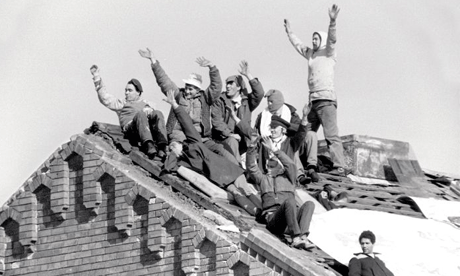
Tuesday, 8 September 2009

Upcoming Attractions

Right, now I've setup the new blog (see www.andnowforsomethingcompletelysectarian.blogspot.com) its time to figure out what to do with the old one. Should I delete everything non-crime and criminology related? Should I just post my own stuff or do some reposts on it off other articles that I think are interesting on this subject? Who knows, I'm gonna mull that question over for a while.

What I do want to do is get some new material up on the blog. Posts perhaps aren't gonna be all that frequent (maybe once a week on average), but I have got some things I did want to post.
For example, I came across a few pieces by James P Cannon in his book Notebook of an Agitator on crime which I want to post some commentary on. I want to post up some more material on Haiti as well as examining 'humanitarian' intervention in some other places too.
One piece that is finished and will be posted up at the end of this month is a review I have written for the current issue of Socialism Today (http://www.socialismtoday.org/). The book is a history of the Prison Officers Association called The Everlasting Staircase by David Evans with Sheila Cohen. If you're interested you can get a copy of this months issue from the website above or your local Socialist Party branch.

Friday, 4 September 2009

New Blog

I've done it - I am going to split this blog in two. I'm still in the process of figuring out how that works completely, but from now on this blog will just feature posts on crime, criminal justice and other related issues.
For everything else, please see my new blog - And Now For Something Completely Sectarian

Thursday, 3 September 2009

Some Thoughts On Blogging

Like an idiot I have once more left the review I was going to post here on my laptop - so instead I originally quickly plugged some new blogs by Socialist Party members.

But then I got thinking about the blog. When I started the blog, I did want to write criminology posts, but also to comment on stuff around me. Both of which I think are dead useful, but of late, I feel a compulsion to keep churning out posts, some of which I know aren't that good quality at all and also I tend to frequently repost stuff too.
The problem I find is that often a lot of the crime related stuff tends to be more polished stuff that is intended for publication somewhere, whereas often I like to rant about other things, yet I feel that sort of thing lets the blog down. So I'm toying once more with the idea of splitting the blog into one which is to do with me, and a more specialised one on crime. We'll see in the next few days if I go through with it

Anyways, back to the blog plugs

First off there is Grinning in Your Paradise - written by a comrade who describes himself as hopping between Sheffield and Cambridge.

Then there is Everyones' Favourite Comrade - this one is written by a comrade in Cardiff who has set up the blog "for several reasons which include, to more orientate and structure my rants, to encourage my to write and read regularly as I get distracted easily and generally to get my specific views out there!"

Finally, I just wanted to once more plug again Proper Tidy - if you're looking for socialist analysis of the key issues in North East Wales look no further!

Wednesday, 2 September 2009

Meme: Political Firsts

I was gonna post up a review of the Naomi Klein based documentary last night, but I've left it on my laptop at hom :( So instead, I'll do this meme I've been tagged in.

First political experience: Would have to be the 1997 General Election. Unlike the other versions of this meme I read, we had no mock polls and my parents aren't of any particular political persuasion (in fact as far as I can tell they vote for whichever candidate of the main 3 parties lives nearest to them). I do remember the children of our local Labour councillors who lived round the corner from me going out chanting Vote Labour!, but I kinda didn't see any difference between either Labour or the Tories.

First vote: 2004 European and council elections, given this was not long too long after the invasion of Iraq, I voted for the parties standing that appeared to be most against the war. So I voted for RESPECT in the European Elections and the Lib Dems in the council elections. By the time of the following general election I'd found my political way a bit more and voted Socialist Alternative.

First demo: To my shame rather than participate in the walkout on Day X i stayed in college cos I was screwing up so much in Maths. However, I did go to an anti-war gig on my birthday in early March 2003 and then went on a later and much smaller protest in Huddersfield where I did a little rant on a megaphone about the invasion of Iraq being all about oil.

Last vote: Would have been the European elections where I voted for No2EU: Yes to Democracy and contributed to us winning 1.1% of the vote. This was the first time that Socialist Party members in North West Wales have ever campaigned in an election - if you exclude student union ones.

Last political activity: I've just come back from a Troops Out of Afghanistan demo which we called off halway through cos it was raining. Apart from Socialist Party stuff, I guess the last other stuff has been selling papers outside Billy Bragg and Mark Steel gigs in Caenarfon (including to the artists themselves!).

Thursday, 27 August 2009

Lockerbie: cynical actions of capitalist governments exposed

From the website of the International Socialists, Scottish scetion of the CWI (http://internationalsocialists.org.uk/joomla/)

The release from Greenock prison of Abdelbaset Ali Mohmed al-Megrahi, the man convicted of the 1988 Lockerbie bombing which killed 280 people, has provoked a storm of political protest. US president Barak Obama called the decision a “mistake”, the Director of the FBI Robert Mueller accused the SNP’s Justice Secretary Kenny MacAskill of giving “comfort to terrorists”, US family members of those killed in the bombing have condemned Megrahi’s release and some Republican senators in the US have called for an economic boycott of Scotland in protest.

The recent debate in the Scottish parliament saw leaders of all the main opposition parties attack the minority SNP government and MacAskill for allowing the terminally ill Megrahi to leave Scotland on compassionate grounds for Libya after spending eight years in prison. A vote of the Scottish parliament on the issue is likely next week. Megrahi was welcomed back to Libya by the Libyan leader, Colonel Gadaffi. In Libya Megrahi is widely seen as having been a victim of a miscarriage of justice. Gordon Brown has so far refused to make any comment on the decision to release Megrahi

Philip Stott

The mood in Scotland generally, and amongst the UK relatives of those killed in the bombing is more mixed. Normally, the idea of releasing an individual who was responsible for the murder of 280 people, even if he was terminally ill with cancer, would be overwhelmingly opposed. However, the fact that many of the UK relatives and others believe Megrahi was not responsible for planting the bomb and that the reality of what happened in 1988 has been deliberately covered up has produced a much more muted opposition to Megrahi’s release amongst some and significant levels of support for his release among others.

1988 – the Lockerbie bombing

Pan Am flight 103 left London Heathrow on December 21st 1988 at 6.25pm for New York’s JFK airport but blew up just after 7pm over Scotland killing all 269 people on board. When the wing section of the plane hit the ground at over 500 miles an hour 11 people in the town of Lockerbie also lost their lives as their homes were vapourised in the intense heat. Debris was found over an 81 mile distance. This was and still is the biggest terror attack ever carried out in the UK. It was also the biggest loss of US lives in a terrorist attack until the events of 9/11 2001.

Forensic investigators found that the bomb had been put into a radio, placed in a suitcase and had been set to go off while the plane was in the air. Despite the eventual accusations made against Libya – that their intelligence agents were responsible for the bombing – the initial focus of the investigations were aimed at the Popular Front for the Liberation of Palestine – General Command (PFLP – GC), who were funded by Iran and headquartered in Syria. The PFLP – GC had carried out attacks on Israel during the 1970’s and 1980’s.

For more than two years it was this line of enquiry that the FBI, the Scottish police and other agencies followed. The suspicion was that the PFLP – GC had been paid to carry out the bombing in retaliation to the shooting down of an Iranian Airbus by the warship USS Vincennes in July 1988. 270 people most of them pilgrims heading for Mecca died in the attack. The Iranian Ayatollah Khomeini vowed the skies would ‘rain blood’ in revenge and offered a $10 million reward to anyone who ‘obtained justice’ for Iran.

Suspected PFLP-GC members had been arrested in Frankfurt two months before the Lockerbie bombing with Semtex explosive devices concealed in Toshiba radios. It was the fragments of a similar radio device that was found to have contained the bomb that blew up Pan Am 103 over Lockerbie. German federal police provided financial records showing that on 23 December 1988, two days after the bombing, the Iranian government deposited £5.9 million into a Swiss bank account that belonged to the arrested members of the PFLP-GC.

Imperialist interests

However, in the run up to the first Gulf War following Iraq’s invasion of Kuwait in August 1990 when the US were looking for support from Iran and Syria (Syria joined the US coalition) the PFLP-GC investigation was stopped. The economic and strategic interests of US imperialism in its intervention in the Middle East were almost certainly the key factor in the decision to abandon the pursuit of the PFLP-GC and the connection with the Iranian and Syrian regimes.

Attention shifted to the Libyan dictatorship of Colonel Gadaffi, who had given support and resources to terror organisations in the past including the IRA and the Abu Nidal Palestinian group, who had carried out horrific attacks on civilians at airports in Vienna and Rome. The US under Ronald Regan and supported by Thatcher had bombed the Libyan capital Tripoli in 1986. In 1999 after years of threats, and economic sanctions Libya agreed to allow two of its intelligence agents, one of whom was Megrahi, to stand trial for the bombing in Zeist in the Netherlands where a Scottish court would sit. In 2001 Megrahi was found guilty by three judges of the bombing. He was eventually sentenced to 27 years in jail in Scotland.

During the trial it was alleged that Megrahi had placed the bomb in the suitcase in Malta, where he had also bought clothes to conceal the bomb in, fragments of the clothing were claimed to be found among the debris at Lockerbie. The suitcase was supposedly then flown to Frankfurt and then to Heathrow where it was transferred onto Pam Am 103. The key witness who claimed to have sold Megrahi the clothing in Malta, Tony Gauci, was paid $2million for his evidence - probably by the CIA.

There was widespread questioning over the outcome of the trial in 2001. Robert Black QC, an emeritus professor of Scottish law at Edinburgh University, was one of the legal architects of the original trial in Holland commented, “No reasonable tribunal, on the evidence heard at the original trial, should or could have convicted him and it is an absolute disgrace and outrage what the Scottish court did.’

An unnamed senior British police officer – known to be a member of the Association of Chief Police Officers in Scotland (ACPOS), which implies that his rank is assistant chief constable or higher – has testified to Megrahi’s defence team that crucial evidence at the trial was fabricated.

Jim Swire, whose daughter Flora died in the Lockerbie bombing, has long believed Megrahi was not responsible for the bombing and has campaigned for a public enquiry made a telling point about Margaret Thatcher who was prime minister at the time of the Lockerbie disaster. “She refused even to meet me, as a representative of the families, to hear our request for a public inquiry. And then, in 1993, in her memoirs, she writes that after she backed the US bombing of Tripoli in 1986, Libya never again mounted a serious attack on the West. How can she write that if she believed Libya was behind Lockerbie two years later? Unless she knows something she is not saying.”

In the meantime the geo-political situation had changed markedly. Following the decision to allow Megrahi to stand trial in 1999 and the attacks on the Twin towers in New York in 2001 the Libyan leadership let it be known they were prepared to engage with US imperialism. Gadaffi agreed to abandon a nuclear weapons programme and following Tony Blair’s visit to Libya in 2004 the last of the economic sanctions imposed on Libya by the UN and the EU were lifted.

Profits to be made

Moreover, British and US imperialism were licking their lips at the prospects of the enormous profits to be made from contracts with Libya, including its large oil and gas reserves. BP, with its many links to New Labour, has signed a $900 million gas exploration contract to build 17 wells in Libyan territory. The Sunday Herald newspaper reported that: “The Libyan British Business Council, a group whose motto is "building bridges with Libya", advertises its services as making introductions to "high-level" decision-makers, government officials and potential partners.

“The LBBC's chairman, Lord Trefgarne, was Mrs Thatcher's former defence procurement minister, while the group's director general, Robin Lamb, was a one-time Foreign Office diplomat in Tripoli. Oliver Miles, the LBBC's deputy chairman, is the UK's former ambassador to Libya, while board member Sir Richard Dalton is a former British ambassador to Iran. The group's membership list also reads like a who's who of British business, including BG International, British American Tobacco, Barclays Bank, Wood Group and HSBC.

“A LBBC-led delegation to Tripoli in May focused on investment opportunities in Libya's financial institutions, while in June Prince Andrew co-hosted an event at St James' Palace in London with the chairman of the Libya Africa Investment Portfolio. Next month, the group stages an event to discuss the multi-million pound water and desalination contracts the Libyan government is expected to hand out. “

British companies are queuing up to cash in on the opening up of contracts in the financial, defence and energy sectors of Libya.

Peter Mandelson and Gordon Brown have claimed there was no trade deal to allow Megrahi to be released but it is clear that the interests of big business played a key role in the unfolding of these cynical events. Including the signing by Tony Blair of a UK/Libya prisoner transfer agreement in 2007, clearly aimed at Megrahi as he was the only Libyan prisoner in a UK jail at the time.

Scottish legal system in the dock

Megrahi lost his first appeal but the Scottish Criminal Cases Review Commission found in 2007 that a second appeal should be allowed as there were 6 grounds to suspect that a miscarriage of justice had been carried out. These included evidence, not made available to the defence that indicated four days before Tony Gauci in Malta picked out Megrahi in an identification parade he saw a photograph of him in a magazine article linking him to the bombing, undermining the reliability of his testimony.

Other material that would have come out in court included the US intelligence documents that discounted Libyan involvement and blamed Iran in response to the shooting down of the Iranian commercial airliner by the USS Vincennes, a US warship, five months before the bombing. The US Defence Intelligence Agency papers suggested that Tehran sponsored the Syrian-backed Popular Front for the Liberation of Palestine-General Command (PFLP-GC), headed by Ahmed Jibril – a former Syrian army officer.

Megrahi dropped his right to a second appeal just days before he was released. The suspicion is that he was told this would speed up his return to Libya. Had Megrahi won his appeal, it would have been a disaster for the Scottish legal system and exposed the cynical actions of US imperialism. As Robert Black commented: “There was strong pressure from civil servants and Crown officials to bring the appeal to an end”

The SNP, Kenny MacAskill and the Scottish legal establishment together have a common interest in protecting the standing of a so-called “Scottish institution”. As a report in the Sunday Times revealed “an anonymous email sent to a SNP MSP, purporting to come from a justice department official said that Megrahi’s appeal was an “an almighty headache” for the criminal justice system concerned about flaws in the case against Megrahi and vulnerable to accusations that the Crown withheld crucial information from his defence team.

“The priority for the SNP has been to uphold the integrity of the Scottish judicial system, whether it deserves it or not,” said the SNP MSP. “It fits in with the general strategy of the SNP that you don’t rock the boat.To make matters worse for those, and especially the relatives of those victims of the Lockerbie disaster who want the truth the Foreign Secretary Labour’s David Milliband has slapped a Public Interest Immunity Certificate to ensure that “secret” documents on the Lockerbie bombing cannot now be released.

End the cover up

The 270 victims of the Lockerbie bombing and their relatives have and are been treated like pawns in the manoeuvres carried out by successive governments to protect big business interests, imperialist influence and to preserve the “integrity” of a biased and class based legal system here in Scotland.

All documents and evidence related to the Lockerbie events and the legal process must be opened to public scrutiny by democratically elected representatives of the families, their representatives and wider society. This could mark a step towards a real accounting of who carried out the atrocity and into those who have sought to cover up, obscure or divert attention away what really took place.

As Jim Swire whose daughter died on December 21st 1988 has said: “The whole process was a political stitch-up from start to finish, which is something that needs to be gotten to the bottom of.”

The Lockerbie disaster and the events surrounding it underline the need to build a mass socialist alternative to the horrors of war, terror attacks and imperialist domination of our world. The International Socialists and the parties and groups that make up the Committee for a Workers International are fighting for socialist change internationally. We believe that a socialist world would lay the basis for an end to imperialist conflict, terrorism, corrupt dictatorships and the exploitation of the world’s peoples by big business interests.

Sunday, 23 August 2009

Review – Guilty and Proud of It by Janine Booth (2009)

There are certain struggles of the British working class that modern day socialists should make themselves aware of. Amongst those struggles are the 1984-5 Miners Strike, Chartism, 1926 General Strike, but there are also localised struggles that are worth our attention, and the struggle of the Poplar councillors is one of them. Booth, who writes for the blog Stroppyblog and is also a member of Workers Liberty, has done a service by bringing these events to a new audience including myself.
During the huge growth of the Labour Party in the aftermath of the first world war, Labour councillors began to be elected in ever larger numbers to local councils and even began to win control of some of them posing the question of what such councillors should do with their new found powers. After all, what local councils basically do is administer certain aspects of the capitalist system in a given area – should labour councils try and do this in a more humane manner or should they challenge the status quo by attempting to provide local services to meet the needs of the population?
As Booth demonstrates, the Poplar councillors chose the latter, demanding the money to be able to provide higher council wages (including equal pay for males and females!) and pay unemployment benefits without sending people to the dreaded workhouse. Their tactic in this campaign was to withhold the rates that they paid to all London bodies, demanding that rates should be equalised across London to pay for the larger welfare services needed in poorer boroughs, for this action they were imprisoned.
This section of the book is very well detailed, with a very good contrast between the actions of the Poplar councillors and the neighbouring councillors in Hackney which Labour also controlled who pursued the former policy mentioned above under the guidance of Herbert Morrison. One other important thing Booth notes is role of the paper, the Daily Herald, edited by the leading figure of the Poplar councillors, George Lansbury in terms of explaining the councils policy and actions.
Yet I feel the book has several points where I feel it falters. Firstly, whilst being excellent on the background to the struggle all the way up the imprisonment and release of the councillors, the book fails to portray a coherent reason for the eventual failure of the councillors struggle to spread further – certain points are raised, the role of the London Labour Party under the reformist Herbert Morrison, Lansbury being forced to sell the Daily Herald, the defeat of the 1926 General Strike etc. Yet the way these are discussed is like a list rather than explaining how these factors interlinked with each other. The role of different tendencies within the movement, apart from the divide between the councillors and the likes of Morrison, is also not explored with the detail needed to understand fully their roles in the struggle, although there is more detail in this respect within the movements of the unemployed.
A final gripe is in the final chapter dealing with the long-term aftermath of the struggle, whilst this chapter is brief in the events it deals with that is necessarily so, it is a book about Poplar and not everywhere else! Yet I feel it is to brief in dealing with the similar situation in Liverpool in the 1980s – this dispute is just lumped in with the others of that time, but Liverpool was significantly different, firstly it won concessions from the government in 1984 and secondly for the role of organised Marxists within the council. Whilst the author does refer to two books for further reference I do not feel that this does the comparisons between the two struggles enough justice.
In summary the book is well worth reading, despite the above mentioned drawbacks the depiction of the core of the struggle of the councillors around the non payment of London wide rates is excellent, and that after all is the main topic of the book.

Wednesday, 19 August 2009

A Reply From Ed Miliband

Recently I sent a message of protest to Ed Miliband about the loss of jobs at Vestas - this is his reply.
However, as readers of the Save Vestas blog may have noted Skykon, a company that bought one of Vestas other plants in Scotland that they were also attempting to close are putting forward different arguments about the wind turbine market in Britain, saying it is in quite good shape and that they are expanding that particular factory at the present time. He also ignored my original point about nationalisation, so I would imagine this is a standard reply that is being sent out

Thank you for your email about the Vestas factory on the Isle of Wight.
I am very sorry for the people who are losing their jobs. When I met the Vestas management a few months ago, to see how we could help, and when I have spoken to them since then, I have wanted to do all I can to try to find a solution that could help the workforce.
Vestas have made clear that the issue for them was not subsidies from government. The factory makes a different sized blade to the ones used in Britain, so each one it makes is shipped to the US. They wanted to have their production in America to cut some of that journey.
As part of global reductions in their workforce, they are not at the current time converting the Isle of Wight site to make turbines for the British market.
Their biggest difficulty is with planning objections to onshore wind turbines, which have slowed down the growth in the UK market. That is why we are reforming the planning rules and are arguing strongly that people need to see climate change as a bigger threat to the countryside than the wind turbine.
Vestas are keeping a prototype facility at the factory on the Isle of Wight and we are currently considering an application from them for support of an offshore blade testing and development facility, which will employ 150 people initially, and is expected to grow in the future.
Government policy is having a positive effect. Next year alone, the renewable electricity industry will get £1 billion of support because of government action, and the amount of power from onshore wind grew by a third last year, and the amount of offshore wind power grew by 67% - so Britain now has more offshore wind power than any other country in the world.
It is to enhance the prospects for green jobs that we have made available 120 million pounds for offshore wind manufacture in the UK and 60 million pounds for marine development. I recently visited a factory in Wales that employs 800 people and exports solar panels across Europe. The week before I saw a factory that is producing buses that produce fewer emissions, helping climate change and local air quality. Research suggest there could be half a million jobs in renewable energy by 2020.
I believe that to be ready to pursue these opportunities, we must invest in the skills, research, and the infrastructure to help clean energy companies grow – and we are making those investments.
There is government action for different industries and areas of the country, which you can read about at www.hmg.gov.uk/lowcarbon.
In the end, making sure the transition happens as quickly as possible will need government action, it will need dynamic companies, and it will also need us to win arguments around the country that renewable power should have a bigger role in the country’s future.
Thank you again for writing to me.
Ed Miliband